Introduction
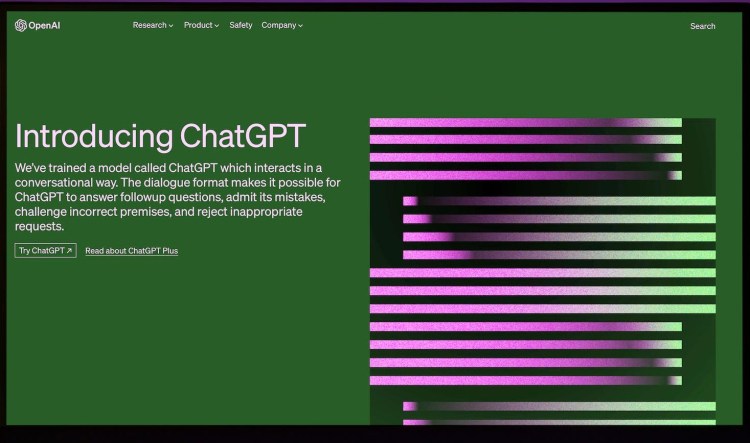
Have you heard about the next big thing in the world of Education? It’s a big technological advancement with a gravitational pull so strong that everyone seems drawn to it. Including BBC, Business Insider, and Global News. “Chat Generative Pre-trained Transformer” or ChatGPT is an artificial intelligence (AI) chatbot created by OpenAI. Based on millions of inputs and feedback it creates human-like text in seconds. The most recent model of ChatGPT is called “GPT-4”. GPT-4 is intelligent enough to score in the 90th percentile on the bar exam (Fowler, 2023), has a yet to be released image interpretation feature (Roose & Newton, 2023), and is available for use with a subscription of $20 USD/ month. While ChatGPT’s earlier iteration “GPT-3” is entirely free to use. ChatGPT is expansive, impressive, and will forever change the world of education.
Not a Fad, the Real Deal
What makes ChatGPT (and other similar AI language models) the “next big thing” is its popularity. Like Google, Facebook, and TikTok that came before it, ChatGPT is viewed as a big deal. Unlike Facebook & TikTok, ChatGPT is not a social media platform, though it is growing in popularity like one. Similar to Google, ChatGPT is changing how humans access information. ChatGPT will have an nth degree effect on education due to the fact that it produces written text so rapidly, instead of having to triangulate using multiple sources.
If you’re an educator, you may be reading this article today because you’ve heard the buzz surrounding ChatGPT at your school and want to learn more. The reality is that your students know about and are likely using ChatGPT this week. Teachers that I know personally have noticed “incredible overnight improvements” in student writing. Only to find out that the improved writing was actually generated by ChatGPT.
Benefits for Educators
- ChatGPT presents myriad benefits for educators. Classroom instruction hinges primarily on culture and relationship. Secondarily, classroom instruction hinges on teacher efficacy and well-constructed lessons. With a few well-worded inputs, ChatGPT can provide: writing prompts, unit plans, lesson plans, etc.
In order to deepen your understanding, I asked ChatGPT to create a lesson plan using only the prompt “Make a lesson plan about the movie Space Jam starring LeBron James for a university class”, ChatGPT generated the following lesson plan… in 15 seconds. Note that I did not edit or format the lesson plan, other than bold the titles.
Isn’t that incredible!

- ChatGPT presents great opportunities to teach students about integrity. Academic integrity is a pillar of the academic community at every level. Teachers & school leaders can be proactive by explaining to students that “plagiarism” means taking credit for work, writing, or ideas that are not your own. Plagiarism shows a lack of integrity and ruins good standing in the academic community. If students partake in plagiarism, in this case by generating written pieces using ChatGPT, they will be plagiarising because they did not make the work they are submitting. This explanation and potential lessons therein takes a strengths based approach and provides students the opportunity to rise to the occasion.
Pitfalls for Education
- Plagiarism is a major pitfall of AI models like ChatGPT. As previously mentioned, young people in your life are certainly using it. Which not only makes it inconvenient for educators to run papers through detection models (more on this later), it also stunts the academic development of the students who use it.
- Educators who thought Wikipedia was difficult to deal with are about to have a field day with ChatGPT. Inasmuch as Wikipedia is an online encyclopaedia that students source information from, without going to or testing the viability of original sources. The same will be exponentially true for ChatGPT. ChatGPT has been trained using millions of inputs/ books/ data sets, but does not browse the internet, therefore is unable to provide sources.
- The proliferation of ChatGPT may lead to a phenomenon that I call “the calculator effect”. The calculator effect is mathematical laziness, developed because calculators are convenient and readily available. When challenged with a mathematical question, one simply reaches for a calculator as opposed to solving the problem using mental math. With ChatGPT, this phenomena may become prevalent related to writing, originality, and creativity.
How to Use ChatGPT
- Go to the ChatGPT website.
- Select “Try Chat GPT”.
- Create an account.
- Verify your email address.
- Click on the text box titled “send a message”.
- Write a prompt or question.
- See what ChatGPT produces.
- Type follow up prompts or questions.
- Provide feedback via the thumbs up/ down emojis to the right of each section of text.
How to Detect if Text Was Written by ChatGPT
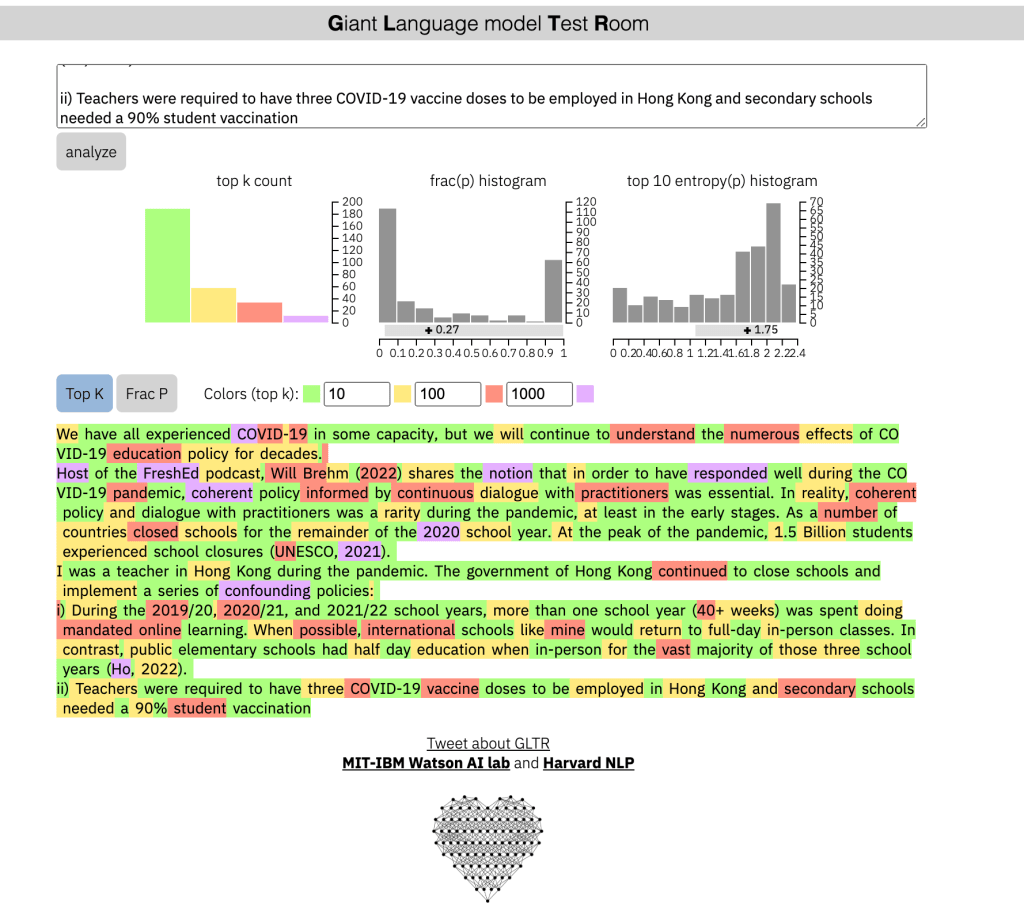
Amazingly, there are online models which can help you to determine if a text was generated by AI. One such resource is the Giant Language model Test Room (GLTR). GLTR was developed by MIT’s IBM Watson Lab & Harvard Natural Language Processing. GLTR uses a series of graphs to indicate the probability of each word. The simplest graph to understand displays green, yellow, red, and (sometimes) purple bars to indicate the number of words in each probability category. Green words are the top 10 predicted words. Yellow words are in the top 100. Red words represent the top 1,000, and purple words are even less probable.
The general idea is that AI writes quite predictably. Therefore, when an AI text is analyzed with GLTR, it is more likely to show tons of green, plenty of yellow, some red, and minimal purple. Human text will often have comparatively lower proportions of green and conversely higher proportions of yellow, red, and purple.
Now it’s time for an example of how GLTR works. Figure 1 and Figure 2 are two examples of text that I asked GLTR to analyze. In order to provide the most accurate results, both sets of text had the same number of words. Figure 1 was generated by ChatGPT. I provided the written prompt for the final question of my university exercise physiology class: “use exercise physiology to explain how pigs can fly, if they actually could” then asked ChatGPT to write it “scientifically”. Note that Figure 1 is mostly green, a fair bit of yellow, some red, and very little purple.
Figure 1

On the other hand, Figure 2 is an excerpt from an article that I wrote in April, 2022 for the well renowned educational leadership blog, josiahmarr.com. Note the higher proportion of yellow words, significantly higher proportion of red words and purple words. Indicating that it was written by a human who used more creativity and unpredictability.
Figure 2
How to use GLTR
- Go to the GLTR website.
- Click on the red box at the bottom of the page titled “try our demo”.
- Erase the text in the text box titled “or enter a text”.
- Copy & paste the text of your choice into the text box.
- Click the grey “analyze” button.
Another, less data-rich method to determine if text was created by AI is to copy it into ChatGPT and ask “Was this text written by ChatGPT or another AI system?” It will analyse the text and provide an answer. In my experience, this is akin to asking a student who speaks another language what their friend said when you’re certain that it was something rude, but don’t know the language yourself. You’re leaving yourself open for a response like “they didn’t say anything bad, they were just telling me about their plans for the weekend”.
Conclusion
Don’t be afraid of ChatGPT. It is an incredible tool that can be leveraged for good. It will not replace educators, on the contrary educators can use it to bolster their work in their specific context. Use ChatGPT as a resource to benefit your students, let it be the topic of conversation around integrity and personal responsibility, and tell your colleagues about it. You could even lead professional development about ChatGPT at the start of next school year for your organisation.
Give ChatGPT a Try! Generate ideas and content, then edit them to your liking.
Feel free to contact me if you would like more information about how ChatGPT can be used in the world of education.
References
Dubey, R., & Shen, N. (2023, March 4). ChatGPT in the classroom: Why some Canadian teachers, professors are embracing AI. Global News. https://globalnews.ca/news/9528069/chatgpt-in-classroom-canada/
Hughes, A. (2023, April 3). ChatGPT: Everything you need to know about OpenAI’s GPT-4 tool. BBC Science Focus. https://www.sciencefocus.com/future-technology/gpt-3/
Sundar, S. (2023, March 1). If you still aren’t sure what ChatGPT is, this it your guide to the viral chatbot that everyone is talking about. Business Insider. https://www.businessinsider.com/everything-you-need-to-know-about-chat-gpt-2023-1
Fowler, G. A. (2023, March 18). ChatGPT can ace logic tests now. But don’t ask it to be creative. Washington Post. https://www.washingtonpost.com/technology/2023/03/18/gpt4-review/
Roose, K., & Newton, C. (2023, March 17). GPT-4 is here, and the group chat bank run (21) [Audio podcast episode]. In Hard Fork. The New York Times Company. https://www.nytimes.com/2023/03/17/podcasts/hard-fork-gpt-4.html
Thank you for taking the time to read this article. It was a pleasure to spend time with you today.
Peace & Blessings,
– Josiah
 Josiah Marr Consulting
Leave a comment