I originally wrote this article in 2019.
Framing the Assumption
An assumption exists in the world today that physical education (PE) is not an essential subject for schools. This assumption manifests itself in the devaluing of PE in both the general public, where it is seen as a lesser subject and school systems where less teaching time is allotted than other subjects. The assumption that PE is not an essential subject results in lower levels of physical activity (PA) in today’s youth and ultimately contributes to some populations being unhealthy worldwide. Today, a common perception of PE is that it is an easy class, a waste of time, uncomfortable, and sweaty. There are different reasons that this assumption exists as part of both the North American and International education ethos, many of which will be examined in this paper as well as refutations for why this assumption should be changed to benefit both this generation and those to come.
Arguments against PE
The assumption that PE is not as important as many other subjects is not without merit. Many governments in the world believe that PE is not as essential as the “core subjects” of science, math, and language. This belief is evidenced by the graduation requirements in school districts in New Brunswick, Canada, located on Canada’s east coast. In New Brunswick, PE classes represent three choices in a sea of thirteen courses all vying for one required course credit (Anglophone East School District, 2019). In contrast to the 23% chance that a student will choose PE to fill this required course slot, there are three required course credits allotted to English, while one each is allotted to math, science, and history. The perception that PE is not an essential subject exists in Canada as well as internationally. At international schools, it is not uncommon for key stakeholders to pursue cutting PE in favor of “more academic subjects”. Even in the context of international schools, where there is an acute awareness of current educational research, PE may not be valued to the degree that it deserves.
Today, the world of education is a complex ecosystem. In which nations battle for supremacy in many ways, one of which is high stakes testing. In the wise words of Harding (2019), many schools believe “if it is not tested, it isn’t taught so time is taken away from PE and added to classes that are tested” (personal communication, August 1, 2019). This could be because they do not believe that PE directly increases scores on standardized tests such as the Programme for International Student Assessment (PISA) in Canada or the Scholastic Aptitude Test (SAT) in the United States. Canada has benefitted from putting a greater focus on subjects which are tested on the PISA, such as English, Science, and Math. In 2017, Canada scored in the top ten countries in the world for Science, Math, and Reading on the PISA (Coughlan, 2017).
When faced with the fact that globally, youth are more sedentary than ever before which correlates to negative health effects (Yang et al., 2019). Many argue that youth PA is not the prime responsibility of today’s schools therefore national recommendations for daily PA should not be met in PE class. In addition, some argue that many youth are involved in extracurricular activities which allow them further opportunities for PA (Garriguet, Colley, & Bushnik, 2017).
Arguments for PE
The assumption that PE is not an essential subject for today’s schools is erroneous. Failing to see the health benefits of lifelong physical education has been and will continue to be detrimental to Canadian society and to the health of the entire world, “Globally, around 23% of adults aged 18 and over were not active enough in 2010… In high-income countries, 26% of men and 35% of women were insufficiently physically active” (World Health Organization, 2019). The WHO’s adult statistics are concerning because, “Insufficient physical activity is one of the leading risk factors for death worldwide”. Even more concerning are the statistics for today’s youth “More than 80% of the world’s adolescent population is insufficiently physically active” (World Health Organization, 2019). Youth are the future, the movers and shakers of tomorrow. If physical inactivity continues to rise from one generation to the next, then the world will be increasingly unwell. This is a primary reason why PE should be considered among the most essential subjects in today’s schools.
Given these facts, it is difficult to understand why PE is allotted less time than other subjects. For instance, at one international school, middle school students partake in 130 minutes per week of PE compared to 195 minutes per week of every other subject. This is not nearly as bad as in New Brunswick, where high school students in grades 9 and 10 have an average of 62.5 minutes of PE per week compared to 125 minutes of every other subject (aside from art, music, and technology). These statistics are concerning when examined through the lens of PE as one of the most valuable subjects that a student can partake in. Stakeholders, governments, and policy makers should value enabling populations to live long lives with fewer health concerns such as, “type 2 diabetes, cancer and cardiovascular disease (Victoria State Government, 2018). Pratt et al. (2000) suggest that lifelong PA leads to longer lifespans with less disease and significant personal and public health care savings. To avoid such physical and financial suffering The Canadian Society for Exercise Physiology (2019) recommends, “For health benefits, children aged 5-11 (and 12-17) years should accumulate at least 60 minutes of moderate to vigorous intensity physical activity daily” (p. 2-3). This recommendation is concerning because New Brunswick high school students are only receiving an average of 12.5 minutes of PE per school day. A fact that, teachers in New Brunswick have expressed concern with “I would argue that PE should be a core subject at all levels of schooling in the province”, “daily PA is a necessity for students”, and “learning to have an active lifestyle is as essential as developing literacy” (personal communication, August 4, 2019).
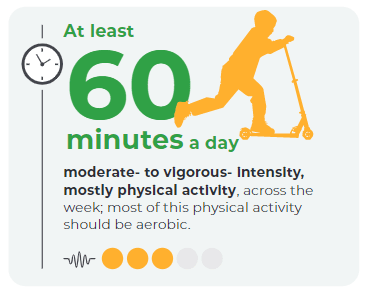
As previously mentioned, there is an argument to be made that PA is not the prime responsibility of today’s schools and that many youth are involved in extracurricular activities which allow them further opportunities for PA. While this is true according to Garriguet, Colley, & Bushnik (2017), data related to the amount which extracurricular activities increase the daily PA for Canadian or international youth has not been quantified. In addition, there are large portions of youth who do not partake in any PA outside of PE class. Not to mention the fact that many families around the world do not have the finances or the time to be able to participate in extracurricular activities. Simply relying on parents to ensure daily PA has led to the aforementioned inadequate levels of PA according to the WHO (2019). Ideally, PE would be increased to 60 minutes per school day, which removes the assumption that parents will model and encourage their children to achieve 60 mins of daily PA (DPA). There is precedent for this, as the concept of DPA in schools was previously implemented in Alberta to a lesser extent, involving 30 minutes of PA during every school day (Schwartz, 2005).
Further, some argue that PE is not essential to today’s schools because it does not directly increase high stakes testing scores. However, significant evidence suggests that PA in fact does lead to greater levels of academic achievement (Kohl III & Cook, 2013; U.S. Department of Health and Human Services, 2010). Although the stakes are high when it comes to large scale assessment, countries like Canada should consider increasing the amount of PE they offer in order to bolster the academic success they have achieved on the PISA.
Other detractors of PE argue that it is not an academic subject, therefore it should not be included in academic environments such as schools. This logic is quite one dimensional and is flawed in many respects. For starters, there are many scientific branches to PE: sport science, sports medicine, physiotherapy, biomechanics, and exercise physiology. There are also many academic branches of PE: sport education, Olympic studies, history of sport, sport psychology, and sport sociology.
In addition, holistic education is a commonly held educational philosophy that seeks to develop the whole child. Holistic education holds to the notion that PA is essential (Miller, 1992). Some would argue that general PE curriculum, which includes PA and the broad subject of health, makes up as much as one quarter of the key sections of holistic education. This is certainly significant.
Personal Thought
All of the aforementioned arguments in favor of PE present overwhelming evidence that supports PE is an essential subject. Personally, I believe that resilience, reflection, collaboration, and encouragement are important aspects of modern education. Coincidentally, these values play major roles in best-practice and pedagogically sound PE. There is no better place than in a PE class to practice encouragement while collaborating with peers to overcome challenges using analysis and reflection throughout the lesson. If this sounds a lot like the 21st century skills (Milton, 2015), that is intentional. The 21st century skills fit perfectly into the PE class. PE is an essential class for students to be as active as possible while inspiring them to continue to develop their understanding of and love for movement throughout their lifetime. This philosophy was inspired by the Canadian not-for-profit organization, Sport for Life which focuses on long term athlete development and lifelong physical activity (Sport for Life, 2019).
Conclusion
The general public perception that PE is not an essential subject is deeply ingrained. It is held by citizens in countries around the world and is embedded in the fabric of school systems and many government’s education policies. The assumptions about the nonessential nature of PE are in direct contrast to the significant evidence that argues that PE should be near the top of the academic priority list. The stark differences in the appraised value of PE may lead to PE battling to establish itself as an essential subject for the foreseeable future. As educators and as people, we should hope that soon, as further evidence emerges about the value of lifelong PA, that PE will become more widely recognized as an essential subject.
References
Anglophone East School District. (2019). High School Course Selection Guide 2019-2020. Retrieved from http://web1.nbed.nb.ca/sites/ASD-E/SiteCollectionDocuments/high-school-handbook.pdf
Canadian Society for Exercise Physiology. (2019). Canadian Physical Activity Guidelines http://csep.ca/CMFiles/Guidelines/CSEP_PAGuidelines_0-65plus_en.pdf
Coughlan, S. (2017, August 7). How Canada Became an Education Superpower. BBC News. Retrieved from https://www.bbc.com/news/business-40708421
Garriguet, D., Colley, R., Bushnik, T. (2017). Parent-Child association in physical activity and sedentary behaviour. Retrieved from https://www150.statcan.gc.ca/n1/en/pub/82-003-x/2017006/article/14827-eng.pdf?st=yDBvj-6V
Kohl III, H. W., & Cook, H. D. (Eds.). (2013). Educating the student body: Taking physical activity and physical education to school. National Academies Press.
Miller, R. (1992). What Are Schools For? Holistic Education in American Culture. Revised. Holistic Education Press, 39 Pearl Street, Brandon, VT 05733-0328.
Milton, P. (2015). Shifting minds 3.0: Redefining the learning landscape in Canada. C21 Canada, 20.
Pratt, M., Macera, C. A., & Wang, G. (2000). Higher direct medical costs associated with physical inactivity. The Physician and sportsmedicine, 28(10), 63-70.
Schwartz, M. (2005). Activating Alberta Schools Every Day. WellSpring, 16(6). Retrieved from https://www.centre4activeliving.ca/media/filer_public/95/cb/95cb1132-c778-4e97-bf64-6890a09b04e2/2005-dec-daily-physical-activity.pdf
Sport for Life. (2019). Catalysts for Lasting Change. Retrieved from https://sportforlife.ca/about-us/
U.S. Department of Health and Human Services. (2010). The Association Between School-Based Physical Activity, Including Physical Education, and Academic Performance. Retrieved from https://www.cdc.gov/healthyyouth/health_and_academics/pdf/pa-pe_paper.pdf
Yang, L., Cao, C., Kantor E., Nguyen, L., Zheng, X., Park, Y., … Cao, Y. (2019). Trends in Sedentary Behavior Among the US Population, 2001-2016. Journal of the American Medical Association. 321(16), 1587–1597.
Victoria State Government. (2018). Physical Activity – it’s Important https://www.betterhealth.vic.gov.au/health/healthyliving/physical-activity-its-important
Thank you for taking the time to read this article. It was a pleasure spending time with you today.
Peace & Blessings,
– Josiah
 Josiah Marr Consulting
Leave a comment